Since childhood, I’ve had two reactions to spiders: (1) drop everything and flee; or (2) whack with lethal force. While rather sheepish later (once my heartbeat returns to normal), my reaction is instinctive and overwhelming.

With no one to blame, I point to the children’s classic Be Nice to Spiders by Margaret Bloy Graham. Mom would frequently read this book to my sister (who’s just as certifiable) and me. Ironically, it was our favorite book. We’d giggle and shriek as the spiders appear (and multiply!), breathlessly terrified and thrilled.

Of course, our reaction (uh, overreaction) to spiders was established before we discovered the book. We simply used our repulsion-attraction to give story time an extra kick.

Later, as an adult, I had to face real spiders alone: no more Dad to whisk them outside. Hence, my two-pronged approach began.

Now, considering yoga philosophy and ahimsa (non-violence) in particular, I know that it’s wrong to smash a spider just for having eight legs (note: six-legged insects are somehow tolerable to me). If, as I wrote in my prior post, I am vegetarian because I cannot without qualms kill an animal, how can I nonchalantly destroy a spider?

Hypocrisies (those little exceptions to our self-proclaimed rules) are more the rule than the exception. I admitted one of mine. What about you? What are your foibles and weaknesses? Where do you diverge from the yamas and niyamas?

In the New York Times article “When Chocolate and Chakras Collide” (January 26, 2010), yoga practitioners debate the yogic diet: Should yogis eat meat? Drink alcohol? Indulge in sweets and spices, onions and garlic?

Traditionalists hold that ahimsa requires vegetarianism, and that one must avoid strong flavors, caffeine, and alcohol, which overwhelm the senses. Revisionists argue that the hardline approach is unnecessary, if one’s attitude is appropriate. Both views make sense. It seems incongruous that a yogi be pleasure-seeking; yet, sticking to the rules doesn’t guarantee saintliness.

My two cents:

CONSCIOUS EATING

In the article, a group gathered for “vigorous, sweaty yoga” followed by a gourmet meal “to allow the yogis to taste, smell[,] and digest in a heightened state of awareness.” The higher-consciousness rationale seems worthy. But isn’t it a no-brainer to appreciate a “multicourse dinner of pasta, red wine[,] and chocolate”?

When I studied Zen meditation under Reb Anderson of Green Gulch Farm, he once described his training. Meals were spartan: a plain soup doled out in limited quantities. Students had to learn to appreciate the humblest sustenance, to be grateful for whatever one receives. (If a server was particularly stingy, they had to squelch any rumblings of resentment!)

To heighten sensory awareness, a simple meal seems more apt than a catered feast. (Better yet, cook your own meal (and clean up).) Mind you, I’m not dissing chocolate and wine. I’m certainly not “holier than thou,” to use quoted yoga teacher Sadie Nardini’s words. But, to me, socializing over a gourmet meal is simply an evening out. A “yoga experience”? Call a spade a spade.

By enjoying yummy food, with their tastebuds on red alert, the group was doing nothing wrong. But if they are really “interested in healthier bodies, clearer consciences and a greener planet,” wouldn’t it be better to volunteer in a soup kitchen or to donate the event fee to Haiti (or to others in need)?

VEGETARIANISM

Since I posted “Ahimsa versus sashimi,” and “Addendum of vegetarianism,” I’ve gone vegetarian. Unless I catch the fish, I’ll forgo it. I grew up eating fish (and poultry, beef, and pork), so I have no sanctimony about vegetarianism. I simply realized two things: First, I cannot without qualms kill an animal (not even a fish). Perhaps I cannot forget how my 15-year-old cat, with congestive heart failure, gasped and suffocated in my arms. Second, letting someone else do the killing lets me too blithely ignore the creature’s life. When I’d order maguro sashimi, my focus was its succulence. I never really acknowledged the creature that died for my pleasure.

This is my choice for myself. I accept others’ choices for themselves. But it behooves us to be clear about our philosophy. Before, I wasn’t.

IS SENSUALITY “YOGA”?

The meat-eating debate reflects a larger question: Is sensual pleasure a yogic experience? In the Times article, David Romanelli, the yoga teacher who presented the dinner event, is said to believe “that any profound pleasure of the senses—a live Bruce Springsteen track, an In-N-Out burger, the scent of lavender gathered in the French Alps—can bring on the ‘yoga high’ that is a gateway to divine bliss.”

Whoa. While I’m all for pleasurable experiences in life, would I call them “yoga”? Everyone experiences sensory highs: parents bonding with their infants, athletes pushing their physical limits, scuba diving in the tropics, romantic love that weathers decades. As humans, we all experience such beauty in life.

To me, what yoga does (or can do) is to crystallize our awareness of the mundane, the simple, the ordinary moments. It’s easy to be awed by life’s obvious pleasures. Yoga develops our sensitivity to subtlety.

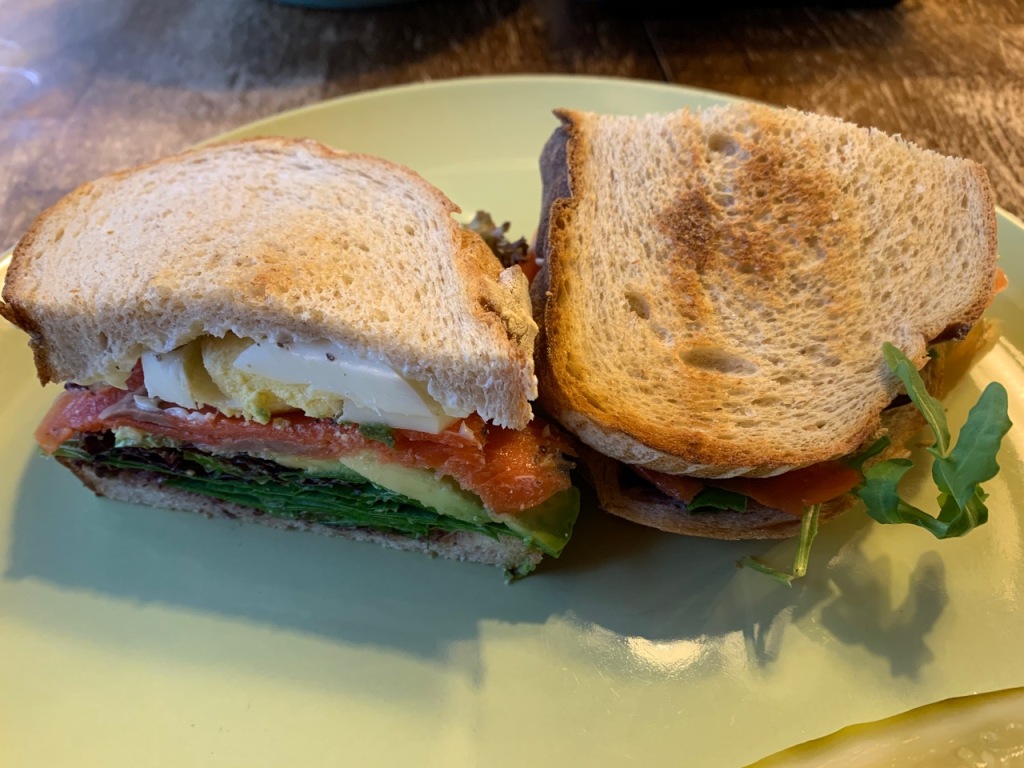
Hamburger image: Vanessa Pike-Russell

A recent Harvard study found that barefoot running causes less impact (and bodily harm) than running in high-tech shoes. Apparently, shod runners land hard on their heels, while shoeless (or minimally shod) runners strike the ground on the springier fore- or mid-foot, which cushions the impact.

Even before this study was published, a small movement toward less cushioned, less supportive shoes was, well, afoot. Nike Free and Vibram FiveFingers (which look like high-tech, low-profile tabis and are geared not only for running but also for water sports and hmm, yoga) exemplify that trend. Christopher McDougall wrote a book, Born to Run, on the phenomenal barefoot running culture of the Tarahumara Indians (see Amazon for an author interview).

Experts seems divided on the actual benefits and feasibility of bare-footed running, perhaps because modern humans are trained from early childhood to wear shoes. See this February 2010 debate on barefoot running in Runner’s World. But a contingent of runners rave about minimalist shoes, as exemplified by Tim Ferriss’s 2009 review (and wave of positive comments).

I’m a big advocate of going barefoot indoors. Where I grew up, all households followed the Japanese custom of removing shoes at the door (which I’d recommend for all humans, although I’m less vocal about it than the Shoes Off at the Door, Please blogger, who’s a Christian Fundamentalist, believe it or not). I’ve spent half my life sans shoes—a habit that I believe cultivated my toe and foot mobility.

That said, long-distance barefoot running sounds risky, if not crazy. Even if kids went barefoot playing kickball in PE, they switched to running shoes to run track or cross-country. No one considered running a marathon without Adidas or Nikes!

In my experience, running shoes with just the right amount of arch support and cushioning help prevent shin splints and other impact injuries. Perhaps the key is to run with a light stride, “brushing” the ground rather than stomping. (I’ve heard that the heel-to-toe roll was “invented” by Nike in the 1950s.) I have a new pair of Brooks hibernating in my closet. Still, I’m intrigued by the minimalist Nike Free and even those weird, wacky FiveFingers.

Note: This post only tangentially relates to yoga, but it’s about feet, the foundation of asana (and among my obsessions!).

Related posts:

In my last post, I riffed on two related, but distinct, themes: the crux of Iyengar yoga and the value of verbal instructions. I perhaps shortchanged both, leading to unintended interpretations. Because I wrote that I never encounter too many asana cues, readers focused on quantity (and, implicitly, quality) of verbal instructions. I cringed as I found readers assuming that I favor a barrage of crazy instructions! (I, too, appreciate an oasis of silence, in class and in the rest of life.)

Reading your thoughtful comments helped me to crystallize my own points:

  • In teaching asanas, verbal instructions (ballpark: three to five per pose) effectively complement demonstrations. If a teacher only demonstrates (or performs the entire class along with students), she is not really teaching. That said, the number of instructions must be appropriate to the students’ abilities.
  • Iyengar yoga is not only about alignment, asana, and the physical practices. The asanas are a means to find ease in the body (and that means any body, any shape, any size, any ability). Ease in the body facilitate ease in the mind and, ultimately, the higher limbs of yoga.
  • Keep an open mind (and avoid blanket conclusions) about other yoga lineages, especially if you aren’t familiar with them!

Learning from the Dog Whisperer

In their comments, Eco-Yogini, Yoga Gypsy, Namaste~Heather, and others wisely noted that verbal instructions must match students’ capacities to absorb information. In other words, there’s no set rule about “how much” to talk, to correct, to adjust, and so forth. A good teaches assesses her students and tailors her teaching to their needs.

One master of this “in the moment” adaptation is Cesar Millan, the famous, Los Angeles-based dog trainer/psychologist. I’d heard about  him, but over the holidays I finally caught his show, Dog Whisperer, on TV.

That day, they were showing back-to-back episodes, so I sat, rapt, watching him deal with a traumatized beagle who’d been attacked; a boxer and a bulldog, both non-neutered alpha-male wannabes, forced to share a space; a lethargic bull terrier who was literally depressed; a rambunctious Great Dane puppy who ran rings around his owners. (I swear, this show is addictive.)

I have two words about Millan’s way with canines: genuine and genius. He can encounter any dog, any behavior, any crisis, and he reacts appropriately. He never works by textbook or agenda. Rather, he keenly observes each unique situation and spontaneously draws from his overall intelligence to act. In some cases, the dogs are aggressive or wild and obviously dangerous. But he knows when to dominate, when to soften his voice. He speaks their language, and they grow to trust him.  He is always in utter control of the situation.

It might seem like a leap from dog trainer to yoga teacher, but it’s not. Both must focus outward, on another’s needs, rather than inward, on one’s own.

During my immersion at the mega studio, I met teachers from various yoga backgrounds. Once, before a class, I chatted with the teacher, whom I’ll call Joan. She’d studied at a Sivananda centre before taking the mega studio’s three-month teacher-training program.

“That’s one type of yoga I’ve never tried,” I commented about Sivananda, which I know only from their ads (and from 1998 Heisman Trophy winner Ricky Williams’s connection to it). “I’ve studied primarily Iyengar yoga,” I added.

“Oh, that’s the exact opposite,” she replied. “Sivananda is not really about alignment. It’s all about the practice.”

Huh?

It was almost class time, and I was there to observe, not to debate. But, inside, it both amused and irked me that she’d defined Iyengar yoga as purely physical, just because of its high standards for form.

In a parallel incident, a gym-yoga teacher  once commented to me that Iyengar teachers tend to “over cue.” She meant that they give too many instructions. Indeed, Iyengar teachers aren’t skimpy with specific tips on asana form:

  • curl the tailbone down
  • widen the collarbones
  • lift the sternum
  • slide the shoulder blades in and down the spine
  • elongate the side waist

And these are the simple examples.

According to the gym-yoga teacher, “Let the students feel their own bodies and figure things out for themselves.”

Is she right? Is it better merely to tell students, “Stand in tadasana, spine straight, shoulders back” and leave it at that?

Regarding beginners, I find that detailed verbal cues are effective. Most beginners are clueless about their physical quirks. They’re oblivious of their shoulders scrunched up toward their ears or of their swaybacked lumbar spines. They might do trikonasana with the arm in parsvakonasana (or vice versa). By verbally directing them from head to toe, students learn to adjust their own bodies and to develop kinesthetic awareness.

Further, beginners are often easily distracted. They check out classmates’ skills. Their minds wander. They struggle with discomfort. When they hear a cue, they return to the asana, to their bodies, to their inner selves.

As a student, I’ve always welcomed cues. Ever too many? No. I absorb the ones that make sense to me, and I let the others waft by.

In Iyengar yoga, one is constantly “refining” the asana, sharpening one’s sensitivity. The initial focus is, yes, on the body. But eventually one focuses on the mind itself. To me, working on alignment and form is actually  training the mind for pratyahara (sensory control), dharana (concentration), and dhyana (meditation), the higher limbs of yoga.

I hope that Joan learns more about Iyengar yoga, but perhaps it simply will never resonate with her. Perhaps one is drawn to particular yoga lineages based on one’s personality. I’d find loose, anything-goes yoga only a diversion. And trance dance and loud sighing would feel silly and fake. But they might well suit others. Conversely, the detailed, thoughtful approach of Iyengar yoga challenges my body, hones my mind, and appeals to me.

In the San Francisco Bay Area, Funky Door Yoga (a Bikram joint), used to use the slogan, “A regular yoga practice gives you a great butt.” (Note: I just checked the website and it now states, “A regular yoga practice gives you great legs.”) Yes, we’ve all heard about the yoga butt, yoga abs, yoga toes.

But what about yoga arms? No, I’m not talkin’ about sinewy muscles but arm position. In Iyengar yoga, teachers emphasize classic yoga arms: straight but not stiff (including wrists and fingers). If tight shoulders prevent you from raising your arms straight and parallel, in line with the ears, just separate them into a “v” shape. This ain’t ballet!

I assumed that all yoga lineages followed the straight-arm rule, until my recent adventures at the mega studio. There, some teachers were Iyengar acceptable, but others (with otherwise decent asana practices) consistently flouted this rule.

Some softly flexed their elbows. Others (and this offshoot amused me to no end!) kept their elbows straight but cocked their wrists and splayed their fingers in a dramatic flamenco-rivaling gesture. This is the closest image I could find.

Whassup with that?

In the beginning yoga class that I teach, a student I’ll call Chris finds savasana uncomfortable. Neither lumbar pain nor mental agitation is the culprit. She tucks her shoulders to open her chest, and she looks fine. But she never feels quite right.

She’s a side sleeper, so lying supine doesn’t come naturally to her. So, I am trying to help her find ease in stage one of savasana, the basic physical form.

Savasana and me

In my home practice (done at a community center, as I discuss in the footnoted posts), I skip savasana because I’m in a public setting. While I continue my downward dogs and backbends regardless of passersby, I am certainly aware of them; I’ll engage in small talk with the staff and custodians, or move to another space if I’m in the way. But I’m hesitant to lie flat on my back with closed eyes even for a minute. Savasana requires privacy, a sense of safety, no interruptions or inhibitions.

During classes, I’ve always welcomed savasana (unlike Chris, I am a back sleeper and lying flat on my back is a relief). But has my savasana practice developed over the years? During my first classes at a university gym, the setting was minimalist: large studio or even basketball court; only mats and straps; no heating system. But the teaching was excellent, and savasana was an “experience.” My body temperature would palpably drop during savasana, signaling the shift from action to relaxation.

Today that shift comes less consistently. While I can execute other asanas better than I could as a novice, my savasana has somewhat stagnated.

The meaning of corpse in corpse pose

Savasana translates to “corpse pose,” but yogis often brush off that word. Corpse = death. Relaxation has become the focus. In an online article, Judith Hanson Lasater wrote the following practical advice:

“[T]eaching savasana teaches much more than relaxation. It teaches clearly and concretely the importance of being[,] not just doing. Our culture is very much a “doing” culture; we value action and results over being and awareness. Savasana may be the only time during the week that the student is quiet and present, not acting, not achieving, not sleeping, just being present. This is the beginning of meditation and an extremely important gift you can give to your class. Always allow 20 minutes for deep relaxation.”

But should we also consider the corpse part? In her essay “Savasana,” Shambala Sun, July 2003, Tara Bray discusses this pose in light of her mother’s death at age 36, when she was 13. Here, doing savasana means facing the “little death” and contemplating one’s mortality.

Oakland yogi Richard Rosen’s thorough discussion, “Shavasana: Corpse Pose,” describes this pose as a symbolic dying, to release oneself from habitual ways of thinking and acting, to promote “genuine physical and psychological rest and self-recognition of our authentic nature.” Read his piece for detailed instructions and thoughtful comments on this ubiquitous but oversimplified pose.

Related posts:

Image: Paul Komarek

In the February 2010 issue of Yoga Journal, Jessica Berger Gross wrote “An Honest Meal,” about how yoga changed her relationship with food. It’s a neat summary of her memoir, enLIGHTened, which I reviewed in my second blog post, “Do yoga, lose weight,” last August. (I recommend reading the whole book, which more satisfyingly details her backstory and personality.)

While I was a bit underweight in high school and college (being thin had its own stigma, by the way), I could relate to eating hangups. During stressful periods in my 20s, I’d occasionally eat for psychological comfort rather physical need (granola, with its vague portion size, was particularly easy to abuse!). I’d also go through stages of health-nut zeal, eschewing not only meat, butter, and chocolate, but even olive oil and egg yolks! (I’m still vegetarian but on affectionate terms with dairy, eggs, and the cacao bean.)

The issue for me was not weight but control, whether too little or too much. Essentially, I was eating unnaturally. In her book, Gross’s then-infant son and pet dog exemplify natural food regulators. They eat when they are hungry. They stop when they are full. On active days, they eat more. On sedentary days, they eat less.

But even animals can have food hangups. My kitty, Gingy, couldn’t seem to self-regulate her intake. I had to portion out limited servings twice a day to keep her weight in check. She spent her early kittenhood as a feral cemetery stray, which perhaps taught her that food is scarce. In retrospect, I might’ve underfed her and contributed to her compulsion to clean her bowl.

Whether we’re human or feline, eating in sync with our physical needs is key. Our obsession with food has spanned generations and cultures. Food journalist Michael Pollan is just the latest chronicler, oracle, and advisor on our eating habits. He’ll forever be remembered for his seven-word prescription: Eat food. Not too much. Mostly plants.

His latest book, Food Rules: An Eater’s Manual (see New York Times interview here) contains catchy tips on what and how to eat. Have we so lost touch with this basic act that we need a guide to say, “It’s not food if it’s served through the window of your car”? Or, “Don’t buy cereals that change the color of the milk”?

Even those seeking healthful diets can go overboard. I’d heard the phrase “eating like a caveman” to mean avoiding grains and eating primarily plants and unprocessed foods. But, according to “The New Age Cavemen and the City,” also published in the Times, wackos are now trying to go prehistoric by alternating gorging on meat (as if after a kill) and fasting (between kills).

I might pick up the Pollan book. But my current favorite food book is eating my words, an engagingly witty collection of essays by Vancouver-based food writer and yoga teacher Eve Johnson. She captures the way food is family and history, sensory pleasure and scientific experiment—and shows us how a true foodie appreciates food.

He who controls the present, controls the past. He who controls the past, controls the future.

George Orwell

My free three-week pass at the mega studio elapsed on Monday. I took 25 classes in 20 days. A limited-time offer is a great motivator, isn’t it? Perhaps resolutions serve the same purpose. Here, the impetus is not a deadline but a vow, to oneself.

I rarely make resolutions. If I do, they’re vague (read more novels; don’t lose temper; organize computer files; practice balancing in handstand) and too numerous for effective full frontal attack.

Perhaps I’ll try a new tactic this year. Ever since I read Gretchen Rubin’s post “Quiz: Are You a Moderator or an Abstainer?” on her blog, The Happiness Project, I’ve been aware that I’m the latter. For me, it’s easier to make or break habits by all-or-nothing resolutions.

To me, “daily” or “never” is simpler than “occasionally.” If not daily, a set schedule (every Tuesday and Thursday, for example) also works. Bright-line rules simplify my life by omitting unnecessary decisions. (Snap decisions are not my forte.) Doing a home yoga practice daily makes sense to me. It’s like brushing my teeth. I just get up and do it.

I was reminded again of the moderation-versus-abstention distinction in Rubin’s December post on resisting holiday temptations. While I typically avoid sugary, store-bought sweets, I received some chocolate truffles and amaretto cookies, plus a box of Ferrero Rocher candies, from students in my new yoga class.

Being a freelancer sans office, I had nowhere to leave them for others’ taking, so they somehow got opened and eaten by my boyfriend and me. Now, they’re not poison and we’re both lean (he didn’t give it a second thought). But I wish I’d had an abstainer rule about involuntarily acquired sweets: then I’d immediately have found a way to re-gift or donate them.

That said, here are my all-or-nothing resolutions for 2010:

  • Vary my daily yoga practice: My daily practice is already a given, but I tend to repeat sequences and poses. Now I’ll create a series of practice themes (such revolved standing poses, deep backbending, or long Yin stretches) and cycle through them.
  • Go to bed by 11pm daily: This one will be a doozy. But I suspect that sleeping earlier could be my ticket to a happier life (I kid you not). I’m too-often emailing, working, and especially blogging close to midnight. Now I’ll wrap it up by 10:30pm. Let me repeat. Drop everything. At 10:30pm.
  • Call or email my parents daily: Have you ever stopped and counted the number of years your parents have left? And that’s if all goes well. I live 2,700 miles from my hometown and fly back only once a year. I skipped my 2009 trip and haven’t seen my folks since late 2008. Irregular calls (my current m.o.) tend to fall to the wayside. Perhaps I’m trying to learn from my kitty’s death last year. Jot a sentence; chat about home. Sure, I’m busy, but what’s five or ten minutes?
  • No high-sugar, high-fat, white-flour sweets: Nowadays there are healthy (healthier, anyway)  baked goods so why do I need actual junk food? Substitutes/exceptions: (1) extra-dark chocolate; (2) my own healthied-up baking; and (3) my mom’s care packages.

Against my better judgment, I decided to “browse” at the after-Christmas sales last Saturday.

Purchase #1: After a yoga class at the mega studio I’ve been featuring, I browsed through their book selection. While I’m an Iyengar devotee, I’m also curious about Yin yoga, and I was tempted by Sarah Powers’s Insight Yoga and Bernie Clark’s YinSights. When the staffer announced a 20% discount (that day only), I couldn’t resist and chose the latter.

Purchase #2: While I’m dismayed at lululemon’s burgeoning empire and beyond-trendy vibe, I found my feet stepping into one of their boutiques and my hands rifling through the sale racks. A sale. At lululemon. Unheard of. I found cropped Wonder Unders in denim Luon ($29; regular price $78)  and in brown organic cotton ($49; regular price $68). Whatever I might think of lulu’s corporate strategy, their flagship styles fit perfectly.

I checked the labels. Although “Designed in Vancouver,” both were made outside North America: the cotton one in Peru, the nylon, in China (egads!). Apparently, the company simply cannot find enough garment workers in North America. Staffers assured me of non-sweatshop conditions and efforts to spread its manufacturing worldwide, not only to China.

I wanted time to mull over them, but they don’t do holds. The upshot: I got both.

Purchase #3: I recently heard about Second Yoga Jeans from fellow yogi Dhana Musil. The company is based in Montreal and they manufacture in Canada. While I love to do yoga and to wear jeans, the combination seemed incongruous, like drinking a cappuccino on a hot summer day.

Still, when I later spied them at a yoga shop, I couldn’t resist trying on a pair. Wow. Talk about stretchy. I could squat and bend and probably, well, do yoga in them. At the time, I took a pass (I have enough jeans) but last Saturday I found them at another boutique for 50% off. I hemmed and hawed.

Again, I wanted a cooling-off period but they refused to hold the pair for me. Premium denim typically costs upward of $150; at $55, these jeans were a bargain! In a minute, they were mine. (Note: Those are my jeans but not me. I don’t do heels, as I’ve discussed here.)

I suffered from a bit of buyer’s remorse later. Do I really need more yoga leggings and a pair of skinny jeans (which I regard as street clothes, not for actual yoga class)? Of course not. There’s a huge difference between “wanting” and “needing” something.

Believe it or not, I am a frugal person at heart. Earlier this month, I read Sue’s blog post about trying to control and minimize her spending during her two-month yoga study in India. I had to laugh. It reminded me of my “junior year abroad” to England way back when. There, I accounted for all (and I mean all) expenditures during my entire stay. Whether it was spring break train tickets, Sainsbury’s groceries, or a pen for 50p, I jotted the details in little notebooks. I’d never done this before (and never since). But, during that period, it gave me a sense of perspective. How much does it really cost to live as a student in England?

Well, now that I have the leggings and jeans (all “final sale only”), I’ve rationalized their admission into my closet. But I’m reminded again that spending money is tricky with me. Pleasure. Guilt. Desire. Simplicity. Cost. Value. Function. Cool. The competing interests!

The trick is to buy only what you really need or really love. If either needed or loved, cost is no question. That’s the trouble with sales. Half price means nothing if you wouldn’t need or love the thing at full price!

Image: the justified sinner

Next Page »